

Measuring the infinite
Math has a reputation for being hard. What's less known is that it's also really weird

How long is the coastline of Britain?
Answer: as long as you want it to be.
This is not some kind of abstruse and rather lame joke, and if it sounds like it, blame the mathematicians. This is what’s known as the coastline paradox, which is not so much a paradox as it is a property of anything that is a fractal. Fractals are patterns that never “smooth out” when you zoom in on them; no matter how small a piece you magnify, it still has the same amount of bends and turns as the larger bit did.
And coastlines are like that. Consider measuring the coastline of Britain by placing dots on the coast one hundred kilometers apart—in other words, using a straight ruler one hundred kilometers long. If you do this, you find that the coastline is around 2,800 kilometers long.
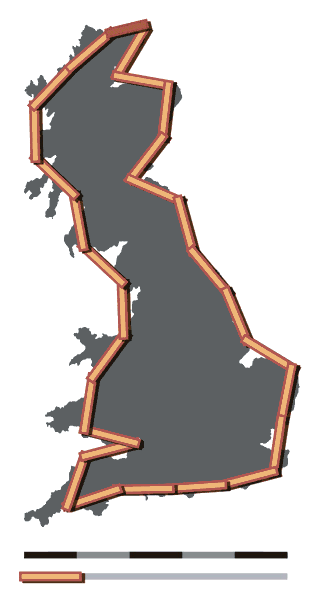
[Image licensed under the Creative Commons Britain-fractal-coastline-100km , CC BY-SA 3.0]

But if your ruler is only fifty kilometers long, you get about 3,400 kilometers—not an insignificant difference.
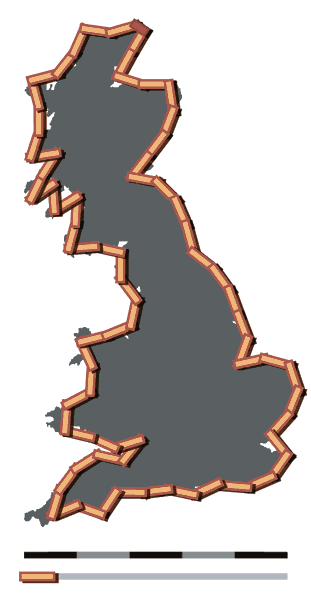
[Image licensed under the Creative Commons Britain-fractal-coastline-50km, CC BY-SA 3.0]

The smaller your ruler, the longer your measurement of the coastline. Eventually, you’re measuring the twists and turns around every tiny irregularity along the coast, but do you even stop there? Should you curve around every individual pebble and grain of sand?
At some point, the practical aspects get a little ridiculous. The movement of the ocean makes the exact position of the coastline vague anyhow. But with a true fractal, we get into one of the weirdest notions there is: infinity. True fractals, such as the ones investigated by Benoit B. Mandelbrot, have an infinite length, because no matter how deeply you plunge into them, they have still finer structure.
Oh, by the way: do you know what the B. in “Benoit B. Mandelbrot” stands for? It stands for “Benoit B. Mandelbrot.”
Thanks, you’re a great audience. I’ll be here all week.
The idea of infinity has been a thorn in the side of mathematicians for as long as anyone’s considered the question, to the point that a lot of them threw their hands in the air and said, “the infinite is the realm of God,” and left it at that. Just trying to wrap your head around what it means is daunting:
Teacher: Is there a largest number?
Student: Yes. It’s 10,732,210.
Teacher: What about 10, 732,211?
Student: Well, I was close.
It wasn’t until German mathematician Georg Cantor took a crack at refining what infinity means—and along the way, created set theory—that we began to see how peculiar it really is. (Despite Cantor’s genius, and the careful way he went about his proofs, a lot of mathematicians of his time dismissed his work as ridiculous. Leopold Kronecker called Cantor not only “a scientific charlatan” and a “renegade,” but “a corrupter of youth”!)
Cantor started by defining what we mean by cardinality—the number of members of a set. This is easy enough to figure out when it’s a finite set, but what about an infinite one? Cantor said two sets have the same cardinality if you can find a way to put their members into a one-to-one correspondence in a well-ordered fashion without leaving any out, and that this works for infinite sets as well as finite ones. For example, Cantor showed that the number of natural numbers and the number of even numbers is the same (even though it seems like there should be twice as many natural numbers!) because you can put them into a one-to-one correspondence:
1 <-> 2
2 <-> 4
3 <-> 6
4 <-> 8
etc.
Weird as it sounds, the number of fractions (rational numbers) has exactly the same cardinality as well—there are the same number of possible fractions as there are natural numbers. Cantor proved this as well, using an argument called Cantor’s snake:
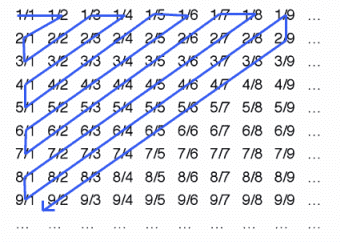
Because you can match each of them to the natural numbers, starting in the upper left and proceeding along the blue lines, and none will be left out along the way, the two sets have exactly the same cardinality.
It was when Cantor got to the real numbers that the problems started. The real numbers are the set of all possible decimals (including ones like π and e that never repeat and never terminate). Let’s say you thought you had a list (infinitely long, of course) of all the possible decimals, and since you believe it’s a complete list, you claimed that you could match it one-to-one with the natural numbers. Here’s the beginning of your list:
7.0000000000...
0.1010101010....
3.1415926535...
1.4142135623...
2.7182818284...
Cantor used what is called the “diagonal argument” to show that the list will always be missing members—and therefore the set of real numbers is not countable. His proof is clever and subtle. Take the first digit of the first number in the list, and add one. Do the same for the second digit of the second number, the third digit of the third number, and so on. (The first five digits of the new number from the list above would be 8.2553...) The number you’ve created can’t be anywhere on the list, because it differs from every single number on the list by at least one digit.
So there are at least two kinds of infinity; countable infinities like the number of natural numbers and number of rational numbers, and uncountable infinities like the number of real numbers. Cantor used the symbol aleph null—ℵ0—to represent a countable infinity, and the symbol c (for continuum) to represent an uncountable infinity.
Then there’s the question of whether there are any types of infinity larger than ℵ0 but smaller than c. The claim that the answer is “no” is called the continuum hypothesis, and proving (or disproving) it is one of the biggest unsolved problems in mathematics. In fact, it’s thought by many to be an example of an unprovable but true statement, one of those hobgoblins predicted by Kurt Gödel’s Incompleteness Theorem back in 1931, which rigorously showed that a consistent mathematical system could never be complete—there will always be true mathematical statements that cannot be proven from within the system.
So math’s reputation for being hard can sometimes overshadow the fact that it is also incredibly weird.
I still recall the first time I ran into how bizarre math can be, and (unsurprisingly) it involved another twist on the idea of infinity. When I was in Calculus II, my professor, Dr. Harvey Pousson, blew all our minds.
You wouldn’t think there’d be anything in a calculus class that would have that effect on a bunch of restless college sophomores at eight in the morning. But this did, especially in the deft hands of Dr. Pousson, who remains amongst the top three best teachers I’ve ever had. He explained this with his usual insight, skill, and subtle wit, watching us with an impish grin as he saw the implications sink in.
The problem had to do with volumes and surface areas. Without getting too technical, Dr. Pousson asked us the following question. If you take the graph of y = 1/x:
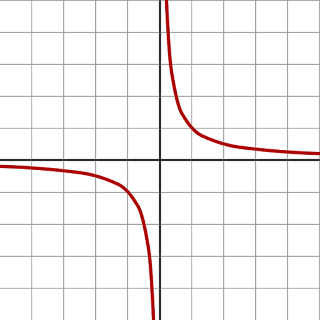
And rotate it around the y-axis (the vertical bold line), you get a pair of funnel-shapes. Not too hard to visualize. The question is: what are the volume and surface area of the funnels?
Well, calculating volumes and surface areas is pretty much the point of integral calculus, so it’s not such a hard problem. One issue, though, is that the tapered end of the funnel goes on forever; the red curves never strike either the x or y-axis (something mathematicians call “asymptotic”). But calc students never let a little thing like infinity stand in the way, and in any case, the formulas involved can handle that with no problem, so we started crunching through the math to find the answer.
And one by one, each of us stopped, frowning and staring at our papers, thinking, “Wait...”
Because the shapes end up having an infinite surface area (not so surprising given that the tapered end gets narrower and narrower, but goes on forever)—but they have a finite volume.
I blurted out, “So you could fill it with paint but you couldn’t paint its surface?”
Dr. Pousson grinned and said, “That’s right.”
We forthwith nicknamed the thing “Pousson’s Paint Can.” I only found out much later that the bizarre paradox of this shape was noted hundreds of years ago, and it was christened “Gabriel’s Horn” by seventeenth-century Italian physicist and mathematician Evangelista Torricelli, who figured it was a good shape for the horn blown by the Archangel Gabriel on Judgment Day.
And no, I can’t explain why it works. I’ve been thinking about this off and on since I first ran into it forty-five years ago, and I’m no closer to comprehending it now than I was then.
Anyhow, that’s probably enough mind-blowing mathematics for one day. I find it all fascinating, even though I don’t have anywhere near the IQ necessary to understand it at any depth. My brain kind of crapped out somewhere around Calculus 3, thus dooming my prospects of a career as a physicist. But it’s fun to dabble my toes in it.
Preferably somewhere along the coastline of Cornwall. However long it actually turns out to be.
Mathematics aside, I wonder if Mandelbrot’s choice of B for a middle initial, when he gave himself a French name, was influenced by his original Polish name Benedykt. Was he throwing us a curve?
Okay, I didn’t know I needed an article that’ll combine geography and math 🤩 I suck at math and don’t understand half of the things you describe here, but boy would I be lying that this wasn’t a fun and quirky read!