


Numerology has a long and storied history.
The Greek mathematician and philosopher Pythagoras, of Pythagorean Theorem fame, believed that numbers and their relationships represented the deepest form of reality; that everything, at its basis, was composed of mathematics. He and his followers did a great deal of research into the “five Platonic solids,” the only convex polyhedra that can be constructed with faces made of regular polygons; the cube (made of six squares), the octahedron (made of eight triangles), the icosahedron (made of twenty triangles), the tetrahedron (made of four triangles), and the dodecahedron (made of twelve pentagons). He thought these were associated with the four elements of ancient Greek science—earth, air, water, and fire, respectively—but after applying some mathematics to the situation Pythagoras realized that this meant there was one Platonic solid left over. So he invented a fifth element, quintessence, that corresponded to the dodecahedron, and that (he said) must be the stuff the heavens were made of.
It never seemed to occur to him that he was basically just making shit up. Of course, he’s hardly the only one guilty of that. The unfortunate thing, though, is that Pythagorean thinking so influenced science for millennia afterward that even a luminary like Johannes Kepler wasted an inordinate amount of time trying to get the orbits of the known planets to conform to some kind of nested geometry of the five Platonic solids. Which, of course, they don’t, and Kepler was eventually forced to give the whole thing up as a bad job. Good thing for him he did finally abandon the idea; his discovery of the Three Laws of Planetary Motion only happened because he was honest enough to realize his Pythagorean model wasn’t working.
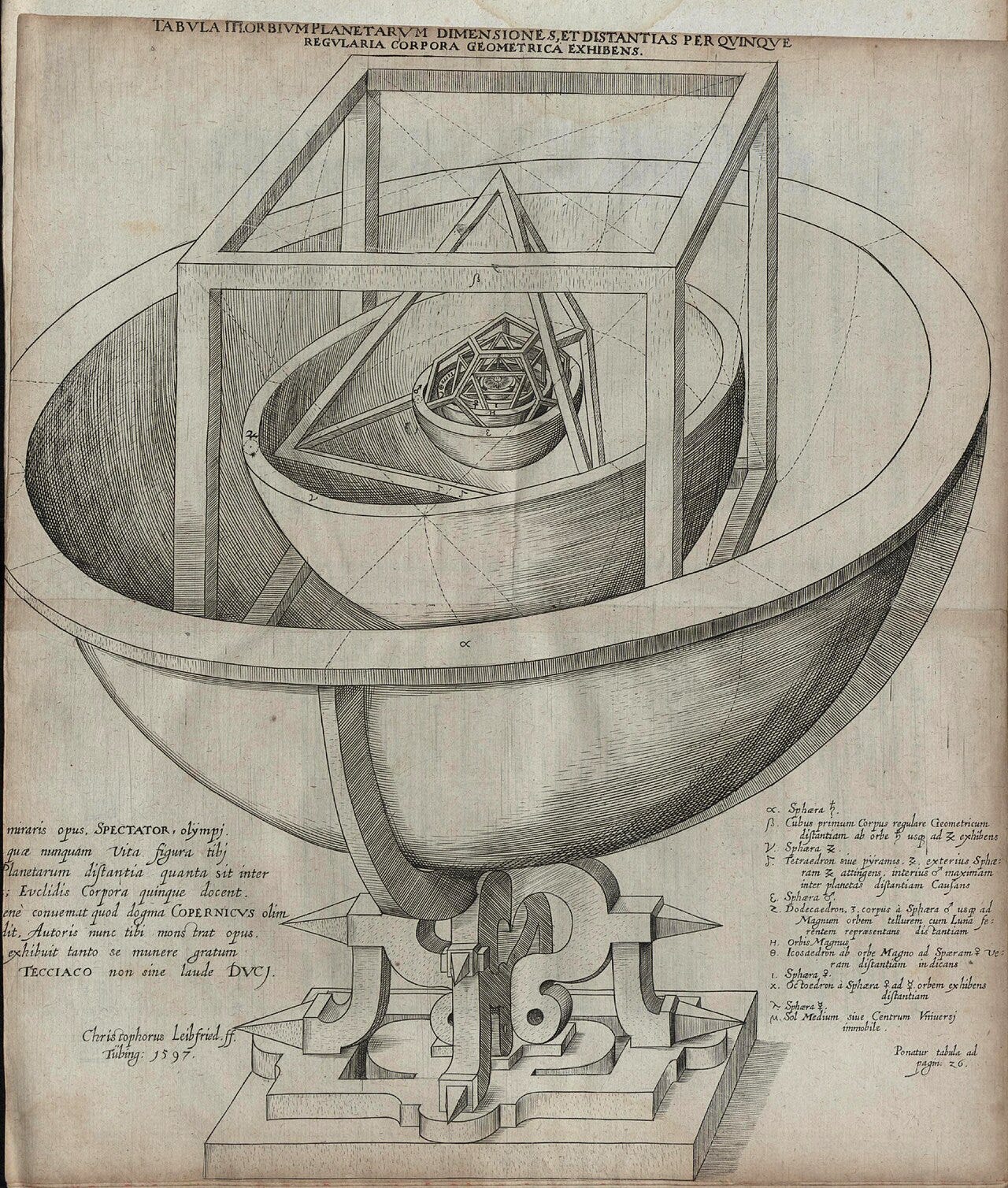
One of Kepler’s failed attempts at rectifying planetary orbits with the five Platonic solids (from Mysterium Cosmographicum, 1596) [Image is in the Public Domain]
The other source for numerology is the mystical musings of medieval Jewish scholars. The idea here was to take passages from the Torah (or other writings) and do a Hebrew numerological analysis of it (called gematria), allowing each letter in the Hebrew alphabet to stand for a particular number, then adding them up in order to find hidden meanings. (This practice is why the same numbers keep coming up in the Bible—particularly numbers like 3, 7, 13, and 40—all of these were numbers of significance in Hebrew gematria.) This is where the whole “Number of the Beast” comes from in the Book of Revelation; most biblical scholars think that 666 is the result when you apply the rules of gematria to the Hebrew transliteration of the name “Nero Caesar,” and that’s why the number got associated with Bad Stuff. Nero, of course, was famous for persecuting the ancient Jews. But then, Nero was a self-aggrandizing asshole who persecuted just about everyone, so it’s unsurprising that his representations in Revelation and just about every other contemporaneous source were highly unflattering.
Even Bugs Bunny took a shot at old Nero
The problem with numerology, though, is that the rules keep changing. There are various ways of assigning numbers to letters, whether in English, Hebrew, Greek, Latin, or any other language, so you can’t help coming away with the feeling that the numerologists already had an outcome in mind and were jiggering around the numbers to make it work out the way they wanted. These days the usual way to do it is to write out all the letters in a grid, starting with A=1 through I=9, start over with J=1, and keep going till you run out of letters. Then you add up the numbers for whatever word or name you’re interested in, sum the digits of the total, and repeat the process till you’re down to a single digit. There’s a standard meaning for each of the digits from 1 through 9; 7 is smart and creative (“lucky number 7”), 4 is weak and passive, 6 is secretive and evil (probably guilt by association from the whole 666 thing), and so on. For example, my name as I usually sign it, Gordon P. Bonnet, would be 7+6+9+4+6+5+7+2+6+5+5+5+2. This gives 69, a number with an entirely different meaning, one I will refrain from going into in the interest of keeping this post PG-13 rated. So, anyway, then you add the two digits together, 6+9 = 15. Then you add those two together, and keep doing it till you're down to a single digit (1+5 = 6).
So, we can see that my name adds to 6, the number of evil incarnate. So maybe there's something to numerology, after all.
Okay, it seems kind of silly, but there are people who take this way seriously, to the point of changing their names if their original one added up to something unpropitious, or demanding a different telephone number because the one they were assigned is eeeeee-vil.
The reason all this comes up is that just a couple of days ago I ran across a new twist on this very old game. Have you heard of Grabovoi numbers? I hadn’t. Supposedly there’s a big conspiracy on the part of the Usual Suspects to use, and also to hide from us ordinary slobs, sequences of numbers that hold hidden powers. They’re named after one Grigori Grabovoi, a Russian mystic who founded a group called Teaching Universal Salvation and Harmonious Development. What Grabovoi claims is that if you put together the right numbers in the right sequence, you can do damn near anything—repair mechanical devices, cure disease, teleport, manifest wealth, even raise the dead. Unfortunately, this last one didn’t work out so well for Grabovoi, who accepted payment in 2008 for claiming he could resurrect the children killed in the Beslan school siege, and was sentenced to eleven years in prison for fraud when the victims stayed dead.
Anyhow, Grabovoi taught his followers that certain number sequences are powerful, and if you know how to use them, you can pretty much do whatever you want. He has authored dozens of books, including (I swear I’m not making this up) Concentration on Numerical Sequences to Reset the Body of Cats, in case your kitty is ailing and you’re not keen on veterinary care. Some of the number sequences are remarkably short; 55515, for example, is supposed to relieve pain if you repeat it over and over.
Nobody much had heard of Grabovoi and his ideas outside of Russia until one of his followers decided to start promoting them on (what else?) TikTok, and now the whole thing has gone viral. There are hundreds, perhaps thousands, of videos extolling the virtues of this or that Grabovoi sequence for manifesting just about anything you can think of. But because no esoteric claim is complete without an accompanying claim that people are trying to suppress it, now there are people with their knickers in a twist about how the CIA is investigating anyone who knows about the Grabovoi numbers, and that there are other special Grabovoi numbers that are so dangerous they’re being kept top secret so we regular folk don’t get a hold of them and cause the End Times or something.
Crazy stuff. But really, when you think about it, it’s not much different than what Pythagoras was doing, is it? Numbers, and number sequences, Mean Something Cosmic, and only the initiates can be allowed to know about it. Carl Sagan, in his groundbreaking series Cosmos, made the persuasive point that however we laud Pythagoras for his insights into geometry, his insistence on mysticism and secrecy actually set ancient Greek science back. If the experimental scientists had prevailed—people like Eratosthenes, a brilliant polymath who famously used observations, a simple test, and a bit of math to estimate correctly the circumference of the Earth—we might be far ahead of where we are now in our understanding of how the universe really works.
Because, like Kepler realized, numerology is nothing more than an attractive fiction. Fun to play with, perhaps, and elegant in a strange sort of way, but not consonant with what we observe unless we somehow shoehorn it into place. Scientific understanding has to rest on one thing, and one thing only; explaining the known data in as parsimonious a fashion as is possible.
And numerology fails rather spectacularly, much as I hate to say it to any mystics amongst my readership. A shame, but that’s the way it goes in science. It bears keeping in mind the famous quote by Thomas Henry Huxley about wishful thinking: “The true tragedy of science is the slaying of a beautiful hypothesis by an ugly fact.”
I really wish I'd taken a picture of my inscription in that numerology book I sent you years ago. I absolutely nailed it!