

Fear and trembling
And why mental illness should not be stigmatized

I am mentally ill.
I say it that openly, and that bluntly, for a reason: mental illness still has a significant and entirely undeserved stigma in our society, a stigma shared by virtually no other group of illnesses. I’ve never heard of someone ashamed to say they have bronchitis, high blood pressure, arthritis, heart disease, or cancer. While no one would question the gravity of any of those or the impact on the patients and their families, none of those carry the same sense of shame—the underlying feeling that somehow, it requires an apology, that it’s the sufferer’s fault for “not trying hard enough.”
“Suck it up and deal.” “Focus on the good things.” “Just relax, you’ll be fine.” “Let go of the negatives.” All, perhaps, well meant, and all entirely useless. Whatever the underlying cause of the terrible anxiety and depression I’ve battled my entire life—whether they’re from a neurochemical imbalance, a genetic predisposition (there is good evidence that depression, at least, runs in both sides of my family), trauma from the emotional abuse I endured as a child, or all three—what I experience is just as real as any symptoms coming from a purely physical illness.
I’ve gone to hell and back trying to find a medication that helps; none of the standard meds made much of a difference, and several gave me horrible side effects. Right now the depression is reasonably well in check from the combination of the compassion and support of my family and friends and a set of coping mechanisms (exercise and creative expression being top of the list).
The anxiety is tougher because it can come on without any warning, and once it starts, I spiral quickly. The latest bout occurred because I have dreadful doctor-phobia, probably precipitated by my mother’s frequent use of “I’ll take you to the doctor” as a threat when I was little—the implication being, of course, that if she did, the doctor would find something seriously wrong with me, and it’d hurt. Bad.
As a result, I have a severe anxiety reaction whenever I even think about anything medical. I’m right back to being that helpless little seven-year-old boy, trembling so hard my teeth chattered whenever I had to have a physical. Although rationally I truly believe all the self-talk I’ve been trained to use—“you are pretty healthy, there’s no reason to think anything’s wrong,” “the doctor is on your side,” “preventative health care and regular screenings are really important”—none of it does much to defuse the overwhelming physical reaction I have.
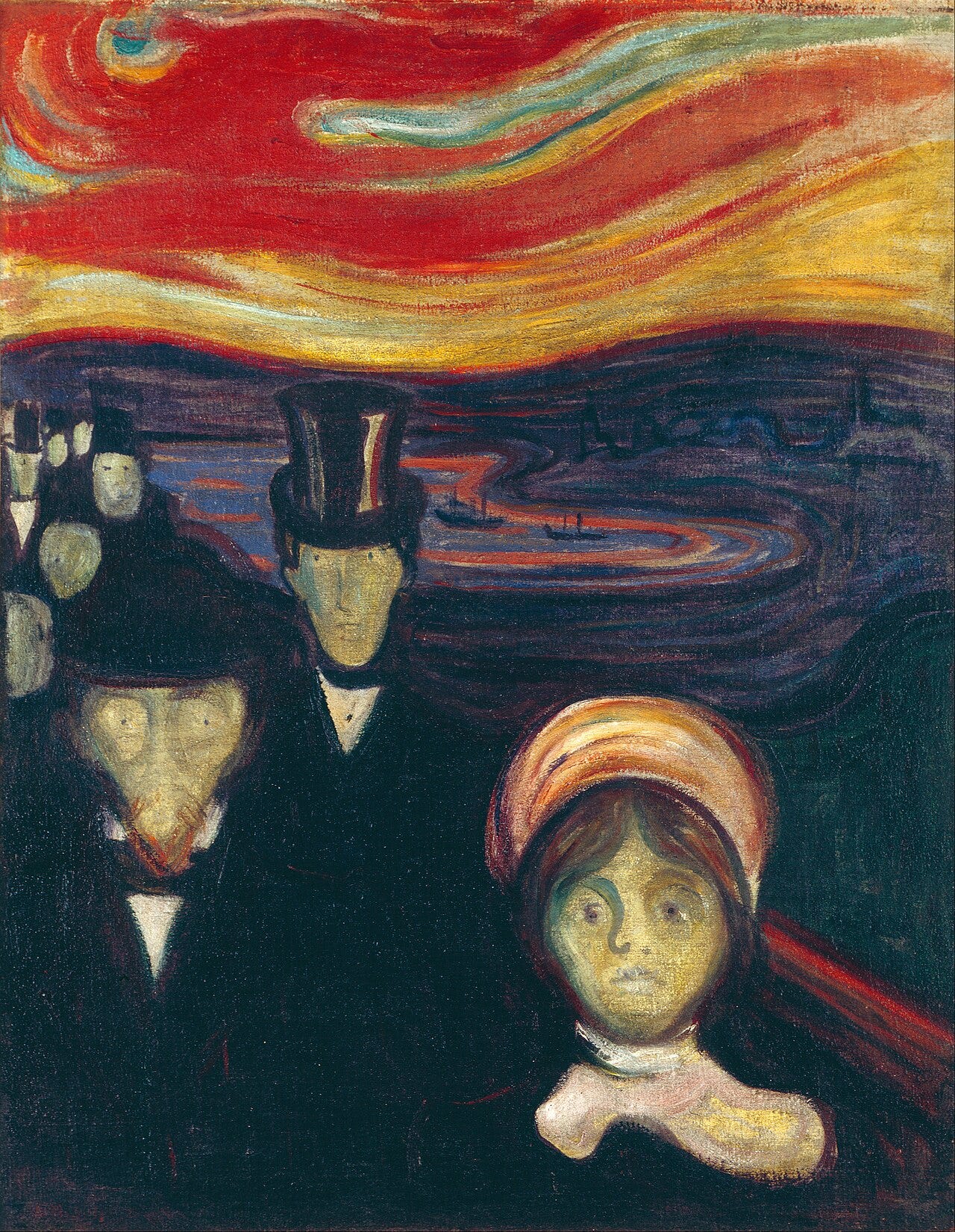
Edvard Munch, Anxiety (1894) [Image is in the Public Domain]
The topic comes up because I went in a week ago to get evaluated for what might be exercise-induced asthma. I get winded quickly when I run, an uncomfortable enough sensation that I have mostly given up the activity, something that used to be a big part of my life. After much hesitation I did the brave thing and called, went in, and the doctor said it’s possible that I have asthma but that another possibility is early angina, so we should do a blood test to check my cholesterol.
The test itself was fine; strangely, I’m not really afraid of needles. But what sent me over the edge was that I had the test on Friday, and had to wait until Monday for the results.
On Saturday night I had the worst panic attack I’ve had in ages. In fact, I thought it was possible I was having a heart attack. My wife, who is not only an R.N. but has loads of good practical common sense, took my vitals and said a heart attack seemed really unlikely. So I took a Xanax and finally got to sleep, and woke up the next morning alive.
Oh, and when I got the results? The way the nurse put it was “they were nearly identical to your last blood test five years ago.”
However, one other upshot of the visit was that because it’s been five years, I now have a full physical scheduled for August 7. I’m trying not to proactively freak out about this. Or, honestly, think about it at all.
On the other hand, my therapist has suggested that maybe avoiding thinking about it is the wrong approach, and has suggested I face my anxiety head-on, which is another reason for my writing this. (When trying to figure things out, some people ponder, some people talk—I write.) She asked me if I was afraid of dying, and the answer was “not really.” What I’m absolutely terrified of is debility—losing mental or physical function, being dependent on someone else for my care. The word “helpless” is an absolutely fraught one for me; it has overtones of being weak, being the victim, being unable to defend myself should the need arise.
I think a lot of it goes back to the fact that as a child, I never felt safe. Not at home, not at school, never. It always seemed that I was lost in a morass of people whose intentions and goodwill I couldn’t trust, and that a smile one moment could be followed up by a fist the next. I became intensely wary, always evaluating my surroundings, always watching for signs that everything was about to go sideways.
Which it did. Frequently. As I got older, my situation didn’t substantially improve, but I did get better at predicting it and avoiding the worst.
If I couldn’t change my situation, I could at least become better at flying under the radar.
My social anxiety and medical-phobia probably originated back then, when I came to the conclusions—understandable considering my circumstances—that (1) no good situation could be expected to last very long, and (2) people who seemed to be on my side, who should be on my side, might very well not be.
So I strove never to be in a position where I was helpless. I managed as an adult by controlling myself and my immediate environment as closely as I could. I never tried to control others—I did not, and still don’t, feel like I had the right to tell anyone else what to do—but I sure as hell could control myself. So that watchfulness and caution I learned as a child never went away. I tend to be very quiet in social situations, because once I say something—well, then I’ve relinquished control over what other people might think about it.
It’s much harder for others to make anything of total silence.
Interestingly, the idea that my anxiety disorder stems from early memories of feeling threatened has some support in the medical research. Most striking is a 2017 paper in Scientific Reports that unequivocally demonstrated the biological basis of anxiety.
The paper, entitled “Neural Circuitry Governing Anxious Individuals’ Mis-allocation of Working Memory to Threat,” detailed research by Daniel M. Stout (of the University of California-San Diego), Alexander J. Shackman (of the University of Maryland), and Walker S. Pedersen, Tara A. Miskovich, and Christine L. Larson (of the University of Wisconsin). The authors write:
Heightened levels of dispositional anxiety confer increased risk for the development of internalizing disorders, including anxiety and co-morbid depression. These debilitating psychiatric disorders are common and existing treatments are inconsistently effective, underscoring the need to develop a deeper understanding of the mechanisms governing individual differences in risk...
Building on prior behavioral and electrophysiological work, functional MRI (fMRI) was used in the present study to quantify neural activity while subjects performed a well-established emotional [working memory] task... The results of our mediation analyses suggest that the amygdala promotes the mis-allocation of [working memory] resources to threat-related distracters. The amygdala is sensitive to a broad spectrum of emotionally salient stimuli, including threat-related facial expressions. In addition, there is clear evidence that anxious individuals show amplified or prolonged amygdala responses to threat-related faces, even when they are task-irrelevant, consistent with our results. Anatomically, the amygdala is well positioned to prioritize the short-term retention of threat-related cues...
[I]t has become clear that information can enter [working memory] via either perceptual encoding or retrieval from long-term memory. From this perspective, [working memory] reflects the temporary allocation of selective attention to recently perceived items or the temporary re-activation of representations stored in [long-term memory]... This suggests that intrusive memories may reflect the mis-allocation of [working memory] resources to distressing material held in [long-term memory].
Put more simply, in anxious people, threat-related long-term memories “leak across” into the working memory, the short-term memory system we use to keep track of everyday occurrences. This is mediated through increased activity in the amygdala, a part of the limbic system of the brain long known to have a connection to anxiety, stress, and obsessive behavior. In an interview with PsyPost, study lead author Daniel M. Stout explained this in more detail:
Anxiety and depressive disorders are very common, challenging to treat, and pose an enormous burden on public health. Having an anxious personality is associated with developing future psychological disorders.
We were interested in this topic because we do not fully understand why individuals with an anxious disposition, like those with an anxiety or depressive disorder, experience high levels of emotional distress in the absence of immediate threat, and spend an excessive amount of time thinking about potential dangers in objectively safe situations.
These types of symptoms are particularly pernicious because they inflict their damage when we need to be focusing on the task-at-hand or at times when we don’t want them to (e.g., during a meeting at work, talking to loved ones, when trying to fall asleep at night). If we can understand what underlies these symptoms, and the brain mechanisms involved, we may be better able to reduce the suffering that many people with high levels of anxiety report.
Earlier work by our group using EEG technology suggested that this might reflect problems with how anxious individuals process threat-related information in working memory. Working memory is a short-term memory system that guides on-going thoughts and behaviors. It is the memory system involved in helping us remember things while we do a task, like remembering a phone number while dialing it.
If threat-related information gains access to or ‘contaminates’ working memory, it can exert a negative influence on our thoughts and actions. For instance, viewing an e-mail informing you that a bill is due can result in increased anxiety and intrusive thoughts about financial troubles; triggering a chain-reaction of uncontrolled worry that spans the entire day.
One other important aspect of working memory is that its capacity is limited, so we can only hold a finite amount of information online in working memory at any given time. So, if your working memory is ‘working’ on the worry-related thoughts, then less working memory capacity is available to attend to tasks important for your job or activities you are trying to complete.
Which certainly squares with my experience. In the two situations that spike my anxiety worst—social situations and doctors’ offices—it doesn’t seem to matter that I objectively, rationally know that I’m safe, that none of the people in the room are judging me or dislike me or want to hurt me. The sensation is of having two brains; the rational one, that says, “These people are on your side, there’s no reason to freak out,” and the emotional reptile brain that says, “I AM FREAKING OUT.”
In conclusion, it’s unequivocal that anxiety, depression, and other forms of mental illness have a biological basis, and the stigma surrounding them is not only degrading, it discourages sufferers from getting the help they need. I mean, it’s hard enough, especially if you (like me) have helplessness as one of your worst triggers.
We still have a long way to go—there are still those who judge people like me as weak or unstable—but far more respond with empathy, with an understanding that we sufferers from mental illness are every bit as deserving of compassionate care as someone dealing with any other kind of illness.
And while understanding that won’t cure us, it certainly goes a long way to making us feel like we’re not so alone.
(IMPORTANT NOTE: if you, or someone you know, are considering self-harm, please call the Suicide Hotline number now. The number is 988, and there are people there who can help you and provide the emotional support you need.)
It is indeed biological, and we definitely need to talk about it more! Thank you for sharing even while feeling vulnerable. 🙏
Wow. I was riveted by this. Learning about the structures of the brain affected by anxiety in particular: “So, if your working memory is ‘working’ on the worry-related thoughts, then less working memory capacity is available to attend to tasks important for your job or activities you are trying to complete.”
There is also what I guess is a milder, less debilitating form of depressive anxiety, which is what I have. It manifests as a hyper vigilance about whatever can go wrong. (You don’t want to go on an overseas trip with me). It has resulted in a highly paid career as a corporate credit analyst. That’s the job, to anticipate what could go wrong. It included contemplating even the most far fetched scenarios (what we used to call “tail risks”) if the loan docs and bond indentures permitted them to happen. When asked what I did, I used to say “I am a professional Eyeore.” The best people at this type of work were not necessarily the smartest, but the most depressed.
I’m told that, in the wild, monkeys observed to have a depressive affect serve an important function in alerting the rest of the monkey troop to potential danger.
I guess my point is that this condition has at its origin some evolutionary purpose. There is still so much to know.
I’m going to save this one to reread and share. You should know that your indelible writing here on Substack despite this illness is very inspiring.